


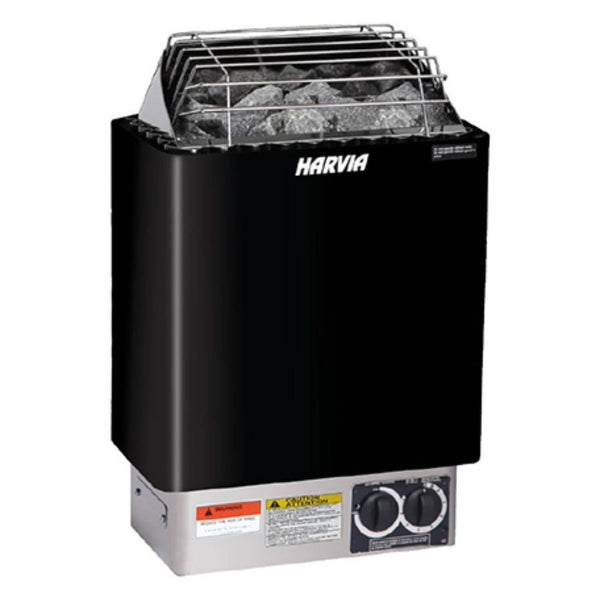
Harvia KIP 6kW Electric Heater
The dealer-standard electric heater for this model — to sauna temp in about 20-30 min. Stones and controller specced at quote.
Learn More


Authorized Dealer
Manufacturer's Warranty Included
Complimentary Shipping
Lifetime Warranty
Lifetime Support
Get your personalized quote
Authorized dealer pricing, free shipping, lifetime warranty — talk to a specialist 7 days a week.
Planning a wellness installation?
Sauna Republic partners with commercial clients on project-based installations — from single-unit boutique studios to multi-unit hotel rollouts. Dedicated project managers, direct-from-manufacturer pricing, and full commercial warranty coverage.


Canadian Cedar Craftsmanship Since 2004
From a small workshop in rural Ontario to backyards across North America, Dundalk Leisurecraft has been handcrafting premium cedar saunas for two decades.
In 2004, a family-owned operation began crafting outdoor cedar furniture in Melancthon (formerly Dundalk), Ontario. What started in a single building with two employees has grown into a three-building operation with fifteen craftsmen, all dedicated to creating the finest outdoor saunas, gazebos, and leisure structures in North America.
Dundalk sources premium Western Red Cedar and Eastern White Cedar from sustainable mills, selecting boards for both structural integrity and visual appeal. Their signature barrel saunas feature 1.5" thick walls, marine-grade aluminum bands, and stainless steel hardware built to withstand decades of Canadian winters.
"Built to bring the authentic sauna experience to your backyard."
The Luna sauna exemplifies Dundalk's innovative spirit—its "rounded square" design provides the efficient heat circulation of a barrel with the extra headroom of a cabin. Models like the Panoramic Pod offer 180-degree views through tempered glass, while the MiniPod brings authentic sauna bathing to smaller spaces.
Limited residential warranty backs every sauna.
Sustainably sourced Western Red and Eastern White Cedar.
Pre-cut, pre-drilled kits for straightforward installation.
FLEXIBLE PAYMENT OPTIONS
Split your purchase into easy monthly payments. Rates as low as 0% APR for qualified buyers. Check your rate in seconds — no impact to your credit score.

Choose Shop Pay at checkout and select installments
Get approved in seconds with no hard credit check
Split into 4 payments or monthly installments
See how affordable your sauna can be
*Payment options through Shop Pay Installments are subject to eligibility check and may not be available in all states. Actual terms may vary based on creditworthiness.
Select Shop Pay at checkout to see your options
All purchases made using Shop Pay Installments are final sale and cannot be returned or refunded.
Please ensure you've selected the right product before completing your purchase. Our team is available at (302) 273-0861 to answer any questions before you buy.
What you see is what you pay. No surprises, no prepayment penalties.
Know your approval status in seconds, right at checkout.
Checking your rate won't affect your credit score.
Pay with any debit or credit card for your installments.
Browse our collection and select Shop Pay at checkout to see your personalized payment options.
Shop SaunasQuestions about financing? (302) 273-0861
We offer free shipping on every order to the continental United States — including saunas, cold plunges, heaters, and accessories. Tracking is provided on every shipment.
Clearlight Saunas & Cold Plunges
7–14 business days (in stock)
Clearlight Accessories & Wellness Devices
5–10 business days
Dundalk LeisureCraft Saunas
8–12 weeks (handmade to order)
Saunas, Cold Plunges & Tubs (All Other Brands)
1–8 weeks
Lumaflex Red Light Therapy
5–10 business days
Everything Else
1–2 weeks
All delivery times are estimates and may extend due to carrier delays or unforeseen circumstances. Backordered items ship when available — we confirm your ETA at time of order. Tracking is emailed as soon as your order ships.
Large items (saunas, cold plunges, hot tubs) ship via LTL freight. Smaller items (heaters, accessories, wellness devices, Lumaflex, red light towers) ship via UPS, FedEx, or USPS.
1. We ship your order. Tracking is emailed to you with the estimated delivery timeline.
2. The carrier calls you. The freight company calls to schedule your delivery appointment. You pick the date and time window.
3. Curbside delivery. Delivery is to the curb via semi-truck with liftgate (when available). You'll need a plan to move it from the curb to its final location.
4. Sign and inspect. You must be present to sign. Inspect for damage before signing — note any issues on the delivery receipt.
The driver delivers to the curb only. You are responsible for moving the product to its final location. Have equipment and help arranged before delivery day.
Rent a forklift — Most common choice. Requires forklift extensions. ~$150–300/day.
Hire a tilt tow truck — Flatbed tow with tilt/slide functionality. ~$200–400.
Hire a rigging/moving crew — Professional movers with equipment. Get quotes in advance.
Tilt tow service (Dundalk only) — Available for $750. Contact us to add to your order.
Clearlight saunas ship in flat panels, not pre-assembled crates. Most can be carried inside by two people without heavy equipment. Dundalk saunas ship in crates exceeding 92" and 800–1,600 lbs — liftgate service is not available for these shipments.
If your order arrives damaged, we'll get you a replacement as quickly as possible.
1. Inspect packaging for visible damage before signing.
2. Note damage on the delivery receipt — write "damaged" and have the driver sign.
3. Take photos of packaging and product damage.
4. Email photos to info@thesaunarepublic.com with your order number within 24 hours.
5. We file the claim and ship your replacement.
Damage must be reported within 24 hours of delivery with photos. Claims filed after 24 hours may not be eligible for a free replacement. Always note visible damage on the delivery receipt — even if it seems minor.
We reserve the right to select the carrier for all shipments.
Small items (heaters, accessories, wellness devices, red light towers) — UPS or FedEx
Large items (saunas, cold plunges, hot tubs) — LTL freight carriers
Lumaflex devices — UPS, FedEx, or USPS
Once large items ship, we cannot change addresses or schedule specific delivery dates. If an item is returned due to an incorrect address, you're responsible for shipping costs both ways. If freight delivery fails because the carrier couldn't access your property, it's treated as a return per our return policy.
Alaska, Hawaii & Puerto Rico — Contact Us Before Purchase
Free shipping does not apply to these locations (except Lumaflex — ships free nationwide). Contact us for a custom shipping quote before ordering. Orders placed without prior approval may be cancelled.
APO/FPO addresses: We ship to military addresses, subject to USPS restrictions. Additional fees may apply.
Remote/hard-to-reach areas: Additional fees may apply. We'll contact you before shipping if your location requires special arrangements.
For any policy omission or clarification, the individual manufacturer policy applies without exception. By placing an order with Sauna Republic, you consent to our shipping and return policies.
Last updated April 18, 2026 · © Sauna Republic. All rights reserved.
Shop Pay Installments — All Sales Final
Purchases made with Shop Pay Installments financing cannot be returned or refunded regardless of product type. Contact us at (302) 273-0861 before purchasing if you have questions.
Applies to all products unless a brand-specific exception is listed below.
30-Day Return — Unused Items, Full Refund
Item must be unused and in original packaging.
Return must be initiated within 30 days of delivery.
Customer arranges and pays return shipping.
All returns require prior authorization from Sauna Republic.
Refund processed to original payment method within 5–7 business days.
If your product is from one of these brands, the brand policy applies instead of the standard policy.
Clearlight Infrared
Clearlight products follow a split return policy based on product type.
All Sales Final — No Returns
All Clearlight infrared saunas (Sanctuary, Premier, and Outdoor models)
Clearlight Cold Plunge
Clearlight Curve Dome Sauna & Amethyst PEMF Mat
Halo One consumables (saline refills, cleaning capsules)
Halo One Breathe Easy Face Mask (personal hygiene item)
30-Day Return — Unused, 25% Restocking Fee
Halo One Salt Therapy Halogenerator
Aroma One Aromatherapy Diffuser
Red Light Therapy Towers (CORE, Full Body, Personal)
Vibrational Resonance Therapy (VRT)
UV Wand, Recliner Chair, Ergonomic Backrest
Conditions: unopened, unused, original packaging, like-new condition. Customer pays return shipping via prepaid freight. 25% restocking fee deducted from refund. Prior authorization required.
Defective Products
Covered by the full manufacturer warranty (Lifetime residential for saunas, varies by product).
Contact Sauna Republic — we handle the warranty claim and arrange replacement.
No restocking fee on warranty claims.
Damaged Shipments
1. Do not refuse the delivery — accept the shipment.
2. Inspect immediately with the delivery driver present.
3. Document damage on the bill of lading — note exact damage, have driver sign.
4. Take photos of packaging and product damage.
5. Contact Sauna Republic within 24 hours — email photos to info@thesaunarepublic.com.
6. We file the freight claim and arrange a replacement at no cost to you.
Concealed damage (not visible until unboxing) must be reported within 15 calendar days of receipt with proof the carrier caused the damage.
Lumaflex
30-Day Return — No Restocking Fee
Applies to all Lumaflex Red Light Therapy Devices (Body Pro Kit, Essential, Essential Pro).
Full refund with no restocking fee.
Product can be opened and used, but must be in full working condition with all original components.
Customer arranges and pays return shipping.
30 days from delivery to initiate return.
Defective units are replaced at no cost under the 2-year manufacturer warranty.
HealthyLine
90-Day Trial — PEMF & Far Infrared Heating Mats and accessories.
90-Day Trial Return
Applies to all HealthyLine heating mats, wraps, bolsters, and covers.
Return must be initiated within 90 days of delivery.
Product may be opened and used, but must show only normal wear with minimal visible use. All accessories must be included.
Customer arranges and pays return shipping.
Refund processed to original payment method within 5–10 business days after the item is received and inspected.
Restocking Fee
No restocking fee for returns in normal condition within the 90-day window.
A restocking fee of 20–50% applies if the product is returned damaged, stained, or with an odor.
Exchanges
Exchanges are available within the 90-day window. If a different item is selected, you pay the price difference or receive a partial refund, as applicable.
Final Sale — Non-Returnable
Items marked "clearance" or "final sale."
Bedding items that have been used.
Defective Products
Contact Sauna Republic first — we coordinate the replacement with HealthyLine.
The defective unit must be received back before the replacement is issued.
If a product arrives damaged, defective, or non-working, replacement and shipping are covered at no cost. If damage is caused by improper use, the customer is responsible for the replacement and shipping.
Warranty
Most AC-powered mats and controllers carry a 5-Year Limited Warranty. Other products typically carry a 1-year warranty.
Warranty claims are filed directly with HealthyLine. Contact Sauna Republic if you need help getting started.
Dundalk Canadian Timber
All Sales Final — No Returns
All Dundalk products (saunas, cold plunges, accessories) are handcrafted to order in Ontario, Canada. Returns and refunds are not available. Full manufacturer warranty applies for defects.
Cancellation
Within 14 days of order — full refund, no fee.
After 14 days — $65 cancellation fee applies.
Once production begins — cannot be cancelled (typically 2+ weeks after order).
Orders containing backordered items are subject to a 6% cancellation fee as we are charged by our payment processor when backorders are cancelled. All lead times are estimates and subject to change.
Our standard return policy applies to all HSA/FSA purchases. Products with brand-specific exceptions follow those policies. There is no IRS requirement that HSA/FSA purchases be final sale.
HSA/FSA refunds are processed back to your original HSA/FSA card within 3–10 business days. Truemed cannot redirect refunds to a different payment method.
HSA holders: Notify your custodian to treat the original purchase as a "mistaken distribution" under IRS Notice 2004-50. Returned funds are not subject to income tax or penalties.
FSA holders: The refund goes back to your FSA plan via the original card. If your plan year has ended, the use-it-or-lose-it rule may apply. FSA holders should be especially sure of their purchase before buying.
If your order arrives damaged, we will resolve it as quickly as possible.
1. Inspect packaging for visible damage before signing.
2. Note damage on delivery receipt — write "damaged" and have the driver sign.
3. Take photos of packaging and product damage.
4. Email photos to info@thesaunarepublic.com with your order number within 24 hours.
5. We handle the claim and arrange replacement.
Clearlight products: Do not refuse delivery — accept, document, and report to us. We file the freight claim and arrange replacement. Concealed damage must be reported within 15 calendar days. See Clearlight policy for full details.
Lumaflex products: Email photos within 24 hours and we arrange a replacement under the manufacturer warranty.
HealthyLine products: Report any damage within 48 hours of delivery with photos. We coordinate the replacement with HealthyLine; if the product arrived damaged or defective, replacement and shipping are covered at no cost. See HealthyLine policy for full details.
Follow the steps for your product's return policy.
Standard Return (Most Products)
1. Email info@thesaunarepublic.com with your order number within 30 days of delivery.
2. We send return instructions and shipping address within 24 hours.
3. Ship the product back — unused, in original packaging. Customer pays shipping.
4. Full refund within 5–7 business days after item is received.
Clearlight — Returnable Accessories & Devices
1. Email info@thesaunarepublic.com with your order number within 30 days of delivery.
2. We confirm eligibility and send return instructions within 24 hours.
3. Ship via prepaid freight — unopened, unused, original packaging, like-new condition.
4. Refund minus 25% restocking fee within 5–7 business days after inspection.
Applies to: Halo One device, Aroma One, Red Light Towers, VRT, UV Wand, Recliner Chair, Ergonomic Backrest. All other Clearlight products are final sale.
Lumaflex Devices
1. Email info@thesaunarepublic.com with your order number within 30 days of delivery.
2. We send return instructions and return address within 24 hours.
3. Ship the product — can be opened and used, must be in full working condition with all original components. Customer pays shipping.
4. Full refund (no restocking fee) within 5–7 business days after receipt.
HealthyLine Heating Mats & Accessories
1. Email info@thesaunarepublic.com with your order number within 90 days of delivery.
2. We send return instructions and return address within 24 hours.
3. Ship the product — may be opened and used, must show only normal wear with all accessories included. Customer pays shipping.
4. Refund within 5–10 business days after the item is received and inspected. No restocking fee unless the item is returned damaged, stained, or with an odor (20–50%).
Warranty claims are filed directly with HealthyLine. Clearance, final-sale, and used bedding items are non-returnable.
Standard return policy (30-day, unused, full refund) applies to all products unless a brand-specific exception is listed. Clearlight saunas, Cold Plunge, Curve Dome, PEMF Mat, consumables, and hygiene items are final sale. Returnable Clearlight accessories carry a 25% restocking fee. Lumaflex devices may be opened and used; no restocking fee. HealthyLine heating mats and accessories carry a 90-day trial (may be opened and used; no restocking fee unless returned damaged, stained, or with odor, in which case 20–50% applies); HealthyLine warranty claims are filed directly with the manufacturer. All Dundalk products are final sale.
All returns require prior authorization. Unauthorized returns will not be accepted. Refunds processed to original payment method within 5–7 business days (HealthyLine returns within 5–10 business days after inspection). HSA/FSA refunds go back to the original HSA/FSA card within 3–10 business days.
Shop Pay Installment purchases are final sale — no returns or refunds. Backorder cancellations are subject to a 6% fee.
We may modify return terms. Purchases are honored under the terms in effect at time of purchase.
Questions About Returns?
(302) 273-0861 · info@thesaunarepublic.com
Monday – Sunday, 9 AM – 5 PM EST
For any policy omission or clarification, the individual manufacturer policy applies without exception. By placing an order with Sauna Republic, you consent to our shipping and return policies.
Last updated June 12, 2026 · © Sauna Republic. All rights reserved.

Qualified customers save ~30% with pre-tax dollars. A Letter of Medical Necessity is required — Truemed handles it at checkout.


Authorized Dealer for 12+ Premium Brands

Select "Truemed - Pay with HSA/FSA" at checkout.

An independent licensed practitioner reviews your answers and, if you qualify, issues a Letter of Medical Necessity (LMN).

Pay with your HSA/FSA card, or use a regular credit card and submit for reimbursement later.
HSA/FSA accounts allow you to use pre-tax money for qualified health expenses. Because you're spending dollars that were never taxed, you keep more of your income.
See how much you save using pre-tax HSA/FSA funds
HSA/FSA purchases are covered by the same return policy as all Sauna Republic orders. If you need to return a product, refunds are processed back to your original HSA/FSA card.
Refunds typically take 3-10 business days to appear on your statement. Some products are final sale regardless of payment method — see our full return policy for details by brand.
Have questions before purchasing? Contact our team — we're happy to help you choose the right product.
Answers based on IRS guidance, Truemed documentation, and real-world HSA/FSA administrator practices.
Qualified customers save ~30% with pre-tax HSA/FSA dollars. Select "Truemed - Pay with HSA/FSA" at checkout.
*Tax savings estimate based on a 30% combined federal/state tax rate. Actual savings depend on your individual tax situation. Truemed facilitates the Letter of Medical Necessity process through independent licensed healthcare providers. HSA/FSA eligibility is determined by the healthcare provider based on your individual health assessment, not by Sauna Republic. Not every customer will qualify. Final reimbursement decisions rest with your HSA/FSA plan administrator. Please consult your tax advisor for personalized guidance. Truemed is for qualified customers. HSA/FSA tax savings vary. Learn more at truemed.com/disclosures.
Have questions about our offerings? Schedule a quick call with our wellness expert.
Upgrade Your Experience
Complementary products and add-ons that pair with your setup. Contact a specialist for pricing and availability.
The dealer-standard electric heater for this model — to sauna temp in about 20-30 min. Stones and controller specced at quote.
Learn More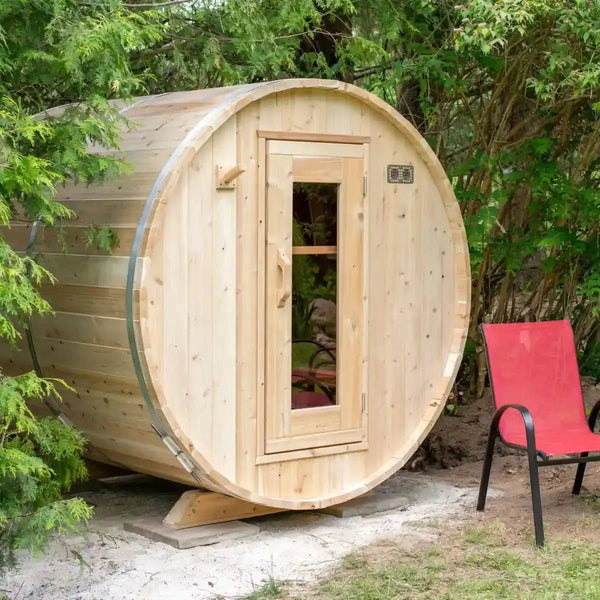
Prefer wood-fired and off-grid? This exact sauna bundled with the Harvia M3 stove — no electrical hookup needed.
Learn More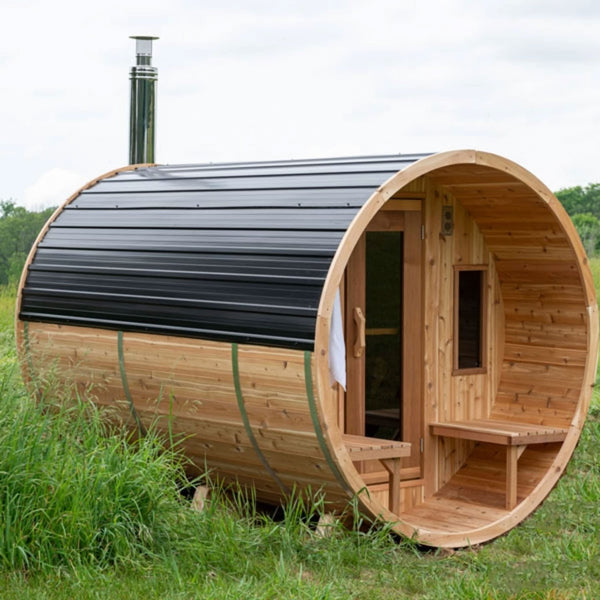
Match your barrel with its weatherproof roof upgrade — pre-cut for the chimney.
Learn MoreBrowse the full range of products and add-ons that pair with your setup — or ask a specialist to tailor it to you.
Sauna Republic gives back
We donate 1% of profits annually to the Arbor Day Foundation
Learn more about Pledge 1% →